|
|
Biographie

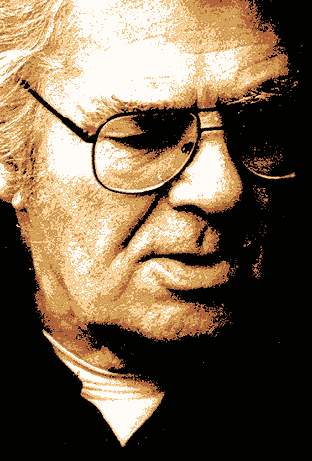
Ahmad Chamlou, considéré comme le plus grand poète contemporain iranien,
est décédé le 24 juillet 2000, à l'âge de 75 ans des suites d'une longue maladie.
Ahmad Chamlou, qui souffrait d'un cancer et de diabète, était hospitalisé
depuis plusieurs semaines. Respecté par les intellectuels laïcs, Ahmad Chamlou
a ouvert la littérature iranienne contemporaine à la contestation politique.
A la révolution islamique en 1979, il était responsable de la revue Jom'éh (vendredi)
dans laquelle il publiait des poèmes politiques, considérés par la critique comme
des "cris contre la pauvreté et l'injustice". Paradoxalement, le poète qui se disait
opposé aux symboles de l'ancienne Perse a commencé à les défendre après le triomphe
de la révolution islamique.
Dans ses dernières années, affaibli et sans ressources, il vivait en reclus s'adonnant
à l'opium. Très malade, il fut été amputé d'une jambe.
Parmi ses recueils les plus connus figurent Ibrahim dans le feu",
Fleurir dans la brume" et le jardin des miroirs.
Chamlou, dont le maître spirituel était Nima Yushidj,
fut l'une des figures
les plus marquantes de la poésie iranienne contemporaine et aussi le traducteur
en persan de Federico Garcia Lorca.
En ermitage près de Téhéran, Ahmed Chamlou, 74 ans, jouissait dans son pays
d'une réputation comparable à celle du Victor Hugo des dernières années.
Chamlou a élevée la poésie au rang d'une religion. Les Iraniens ont pour lui
une telle ferveur qu'elle apparaît presque sacrée, rappelant celle que le peuple
de Paris manifestait autrefois pour le Victor Hugo des dernières années.
En Iran, on offre des poèmes de Chamlou à un amour, à un ami, pour un anniversaire.
A Téhéran, ses livres occupent des rayons entiers dans les librairies.
Principaux recueils
"L'air frais" publié aux Éditions Nil - Téhéran - en 1957
"Le jardin du miroir" publié aux Éditions Morvarid - Téhéran - en 1959
"Aïda dans le miroir et Les instants et toujours" publiés aux Éditions Nil - Téhéran -
en 1964
"Aïda arbre poignard et mémoire" publié aux Éditions Morvarid - Téhéran - 1965
"Le Phénix dans la pluie" publié aux Éditions Nil - Téhéran - 1966
"Les élégies de la terrestre" publié aux Éditions Amir Kabir - Téhéran - en 1969
"S'épanouir dans le brouillard" publié aux Éditions Zamân - Téhéran - en 1970
"Abraham dans le feu" publié aux Éditions Zamân - Téhéran - en 1973
English
Biography
Ahmad Shamlou, prominent Iranian poet, was born in 1925 in Tehran. Shamlou
left behind a large body of poetry, literary criticism and translations.
Arguably the most important poet and writer since Nima Yushij, Ahmad Shamlou
was considered the most important contemporary Iranian poet. Shamlou who spent
his childhood in the Khorassan Province, went to high school in Tehran.
Publishing cultural and literary periodicals were only one of this diligent
poet's jobs. He was the editor-in-chief or director of three periodicals, namely,
Khoosheh, Ketab-e Hafteh and Ashena . In his last unfinished book
titled "Book of the Alley" he coined several Persian slang now widely
used by the public. In the last years of his life he finished a translation of
the novel "Tranquil Flows the Donn" by Mikhail Sholokhov that is to be
published in the near future. He was regarded by critics not only as Iran's
greatest modern poet, but as a poet of world standing, who contributed greatly
to the reformation of Persian poetry which started at the beginning of the 20th
century. He was particularly highly respected by secular intellectuals.
He was a journalist and the editor-in-chief of a literary periodical.
He introduced himself to the poetry
society by publishing his first collection of poetry, "the Forgotten Songs".
He followed Nima's style and composed contemporary blind poems or Free Verse.
"Havay-e Tazeh" (Fresh Air) is a collection of poets, which was the outcome
of 10 years' task. This book brought him more fame and presented him as an
intellectual poet. He was indefatigably in the search of truth. His next book
was "The Mirror Garden". He believes in complete freedom in composition
of poems. He believes that a poet's pen must not be tied by any bonds. He must
not be restricted to any rules. When he feels the need to express himself
through poetry and when a poem is processed in his head, he must reveal it.
In other words such restrictions must not bar the composition of poems.
He considers himself a poet dedicated to the people. He says a poem must
be serving the people and it must be for the people. His third book,
"Ayda in the Mirror" reflect the fact that he no longer loves people,
instead his fury, bitterness and resentment toward them is revealed.
He turns his love instead toward his beloved girl "Ayda". That is when his social
poems change direction and composition of romantic poems starts.
Here romance, while enjoying a philosophical ideology, reaches its peak.
Shamlou nominated twice for the Nobel Prize. Also, being fluent
in French translated some of his own work into this language. He also composed
two colloquial poems, Pariya and Mother Sea's Daughters. His other works
include: Steel and Emotion, Moments For Ever, Abraham in Fire, A Dagger in a
Dish and The Songs in the Alley of Nostalgia. As he was a poet,
a writer and a translator, he left behind books both in prose and poetry,
including a few novels. Ketab-e Kouche that was long on the top of the
best-seller list is a dictionary of colloquial Persian phrases, including
idiomatic expressions and slang. This is the first Persian dictionary ever
published, which also covers all the indecent vocabulary. He also rewrote
Divan-e Hafiz according to his own taste and claimed that it is his
own version of Hafiz. Shamlou passed away in summer of 2000 in Tehran at the age of 75,
leaving behind a number of great literary works in prose and poetry.
|
|---|