|
|
The Pardoner's Tale (End) - (Middle English)
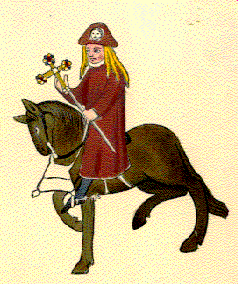
But, sires, o word forgat I in my tale:
I have relikes and pardouns in my male,
As faire as any man in Engelond,
Whiche were me yeven by the popes hond.
If any of yow wole, of devocion,
Offren and han myn absolucion,
Com forth anon, and kneleth heere adoun,
And mekely receyveth my pardoun;
Or elles taketh pardoun as ye wende,
Al newe and fressh at every miles ende,
So that ye offren, alwey newe and newe,
Nobles or pens, whiche that be goode and trewe.
It is an honour to everch that is heer
That ye mowe have a suffisant pardoneer
T'assoille yow in contree as ye ryde,
For aventures whiche that may bityde.
Paraventure ther may fallen oon or two
Doun of his hors and breke his nekke atwo,
Looke which a seuretee is it to yow alle
That I am in youre felaweshipe yfalle,
That may addoille yow, bothe moore and lasse,
Whan that the soule shal fro the body passe.
I rede that oure Hoost heere shal bigynne,
For he is moost envoluped in synne.
Com forth, sire Hoost, and offre first anon,
And thou shalt kisse the relikes everychon,
Ye, for a grote! Unbokele anon thy purs."
"Nay,nay"! quod he,"thanne have I Cristes curs!
Lat be,"quod he,"It shal nat be, so theech!
Thou woldest make me kisse thyn olde breech,
And swere it were a relyk of a seint,
Though it were with thy fundemenr depeint!
But, by the croys which that Seint Eleyne found,
I wolde I hadde thy coillons in myn hond
In stride of relikes or of seintuarie.
Lat kutte hem of, I wol thee helpe hem carie;
They shul be shryned in an hogges toord!"
This Pardoner answerde nat a word;
So wrooth he was, no word ne wolde he seye.
"Now,"quod oure Hoost,"I wol no lenger pleye
With thee, ne with noon oother angry man."
But right anon the worthy Knyght bigan,
Whan that he saught that al the peple lough,
"Namoore of this, for it is right ynough!
And ye, sire Hoost, that been to me so deere,
I prey yow that ye kisse the Pardoner,
And Pardoner, I prey thee, drawe thee neer,
And, as we diden, lat us laughe and pleye."
Anon they kiste, and ryden forth hir weye.
Geoffrey Chaucer
|
The Pardoner's Tale (End) - (Modern English)
But, sirs, one thing I forgot in my tale:
I have relics and pardons in my bale,
As fine as any man in England,
Which were given to me by the pope's hand.
If any of you will, of devotion,
Offer and have my absolution,
Come forth straightway, and kneel down here,
And meekly receive my pardon;
Or else take pardon as we travel,
All new and fresh at every mile's end,
Providing that you offer, again and again,
Gold coins or silver pennies, which are good and true.
It is an honor to every one that is here
That you may have a pardoner with sufficient credentials
To absolve you in the contryside as you ride,
For accidents that may happen.
Perhaps there may fall one or two
Down off his horse and break his neck in two.
Look what a safeguard is it to you all
That I happen to be in your fellowship and at call,
Who can absolve you, both for the great and the least,
When the soul shall from the body pass.
I advise our Host here shall begin,
For he is most envoloped in sin.
Come forth, sir Host, and give your offer first right now,
And thou shall kiss the relics every one,
Yea, for a fourpence coin! Unbuckle thy purse right now."
"Nay, nay!"he said,"then I will have Christ's curse upon me!
Let it be,"he said,"it shall not be, I lat not do teetch!
Thou would make me kiss thine old underpants,
And swear it was a relic of a saint,
Although it were stained by thy fundament!
Now, by the cross that Saint Helen found,
I would I had thy ballocks in my hand
Instead of relics in a reliquarium.
Have them cut off, I will help thee carry them;
They shall be enshrined in a hog's turd!"
This Pardoner answered not a word;
So angry he was, no word would he say.
"Well,"said our Host,"I will no longer joke
With thee, nor with any other angry man."
But immediately the worthy Knight began,
When he saw that all the people laughed,
_"No more of this, for it is quite enough!
Sir Pardoner, be glad and merry of cheer;
And you, Sir Host, who are so dear to me,
I beg of you to kiss the Pardoner,
And draw thyself nearer, Pardoner, I pray thee,
And let's laugh and play again."
At once they kissed, and we rode forth our way.
|
|---|